How to Negotiate Salary in India IT: The 2026 Playbook
First Day AI · 2026-09-30 · 11 min read
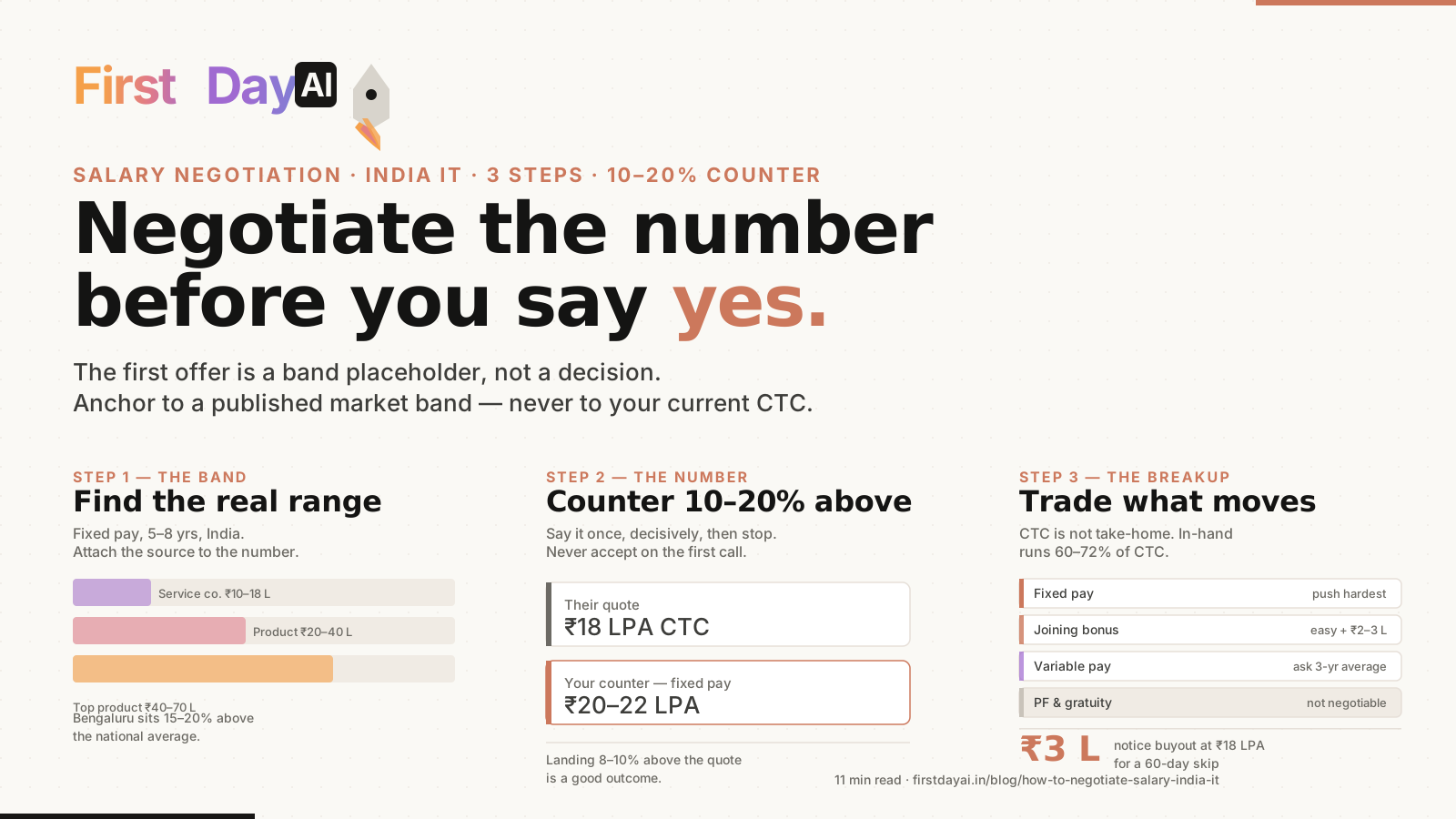
Short answer: negotiate on the day of the call, before you accept anything. Counter 10-20% above the quoted figure, anchor that number to a published market band rather than to what you currently earn, and trade the non-salary terms — notice period, joining bonus, variable pay, designation — before you trade fixed CTC. In India, the first offer is a budget placeholder, not a final number.
Indian IT employers quote the first number from a role band, not from your market value. That band is set before your name is on the requisition, so the first offer is usually the bottom of an internal range with headroom above it. Negotiating is not asking for a favour. It is asking the recruiter to move you inside a range they already budgeted for.
Three things decide the outcome: the number you say, the source you attach to it, and whether you do it before or after you say yes. Everything else — tone, seniority, "am I being too greedy" — is noise.
Why do Indian IT companies lowball the first offer?
Three reasons, all structural rather than personal.
The band is pre-set. Large service companies and product firms build compensation bands per role and level before the search opens. You land at the entry point of the band. The ceiling is not secret — it is just not volunteered.
The first quote is priced, not decided. Gartner's HR Research survey of nearly 3,500 candidates, published in December 2024, found the median number of offers per candidate had fallen to one, down from three in early 2023. With one offer in the market, nothing forces the number upward. A candidate holding two offers at 24 LPA resets the market for everyone else in that band.
Budgets are tight but not closed. The Naukri JobSpeak Index stood at 2,878 points in April 2025, registering 9% year-on-year growth, and the April 2026 edition opened FY27 at 6% growth. In the Naukri Hiring Outlook survey for 2025, 96% of employers expected hiring activity in the first half of the year and 54% planned double-digit salary increases, with 39% planning increments in the 5-10% band. If the recruiter already has a 15% increment sanctioned, a modest counter moves you inside an approved decision rather than a new one.
What is a fair CTC for your role in India right now?
You cannot negotiate against a number you invented. You need a band, and one that is defensible in a call with an HR person who does this forty times a month.
| Experience | IT services / service company | Mid-tier product | Top product / global |
|---|---|---|---|
| Fresher (0-2 yrs) | ₹3.5-6 LPA | ₹8-15 LPA | ₹15-30 LPA |
| 2-4 years | ₹5-10 LPA | ₹12-25 LPA | ₹25-45 LPA |
| 5-8 years | ₹10-18 LPA | ₹20-40 LPA | ₹40-70 LPA |
| 8-12 years | ₹18-30 LPA | ₹35-60 LPA | ₹60 LPA-1.2 Cr |
Two hard anchors for the demand behind this table. The Naukri JobSpeak Report for April 2025 recorded roles paying 20 LPA and above growing 26% year-on-year, while fresher hiring in the 13-20 LPA bracket grew 22% — the top of the market is moving faster than the bottom. The Naukri Gen Z Work Code Report 2026, covered by CNBC-TV18 in June 2026 and based on more than 23,000 Gen Z professionals across 80 Indian industries, found 50% of respondents ranked work-life balance as their top priority after salary, and 14% would leave within a year without growth, against 3% of millennials. Salary gets you the offer; the things around it decide whether you are still there in year two.
City matters too. Bengaluru sits roughly 15-20% above the national average for the same role, with Hyderabad, Pune and Chennai behind it. A Bengaluru offer at the bottom of the band is harder to move than the same band in a tier-2 city, because the recruiter knows the local market is tighter.
How do you negotiate a salary offer in India IT?
Step 1: never say yes on the first call. "Let me think about it" costs nothing, and you need time to get the written CTC breakup — the document you negotiate against.
Step 2: ask for the breakup before you give a number. Fixed pay, variable pay, joining bonus, ESOP value, retention bonus. If the recruiter quotes ₹18 LPA CTC and you counter ₹22 LPA against that headline, you are negotiating a number that includes things you cannot control. Ask which part is fixed.
Step 3: counter at 10-20% above the quote. Not 5%. The conventional range for a lateral move in Indian IT sits at 10-20%, and the recruiter has usually been told to expect a counter. Landing 8-10% above the quote is a good outcome and the single highest-leverage thing in this process.
Step 4: attach the source to the number. "Based on my current 14 LPA plus the band for this role in Bengaluru, I am looking at 20 LPA fixed" is a claim. "Published Bengaluru bands for this role at 5-8 years sit between 20 and 40 LPA, and I have an offer at 24" is an argument. The second gives the recruiter something they can forward to their compensation team without having to defend you.
Step 5: negotiate once, decisively. Multiple rounds over multiple emails read as indecision. One clear email, one number, one reason, then a pause.
The script, in the order you say it:
Thank you for the offer, and I am genuinely interested in the role.

Before I respond, I have two things I need to understand better.

First, could you share the full CTC breakup — fixed, variable, and any
joining or retention bonus? I want to make sure I am comparing the right
numbers, because the fixed component is what I plan to build on.

Second, on fixed pay: I looked at published bands for this role in
Bengaluru at my experience level, and they sit at [X] to [Y] LPA for
product companies of this size. My current fixed is [Z] LPA. I would like
to ask for [number] LPA fixed, which is inside that band.

I want to be clear that I am asking because I want this role, not because
I am comparing it to a different offer. If the fixed number cannot move,
I would like to understand which parts of the package can.
That last paragraph does real work. It removes the implied threat, which is what makes recruiters freeze, and redirects the conversation to the parts of the package you can actually trade.
How do you read the CTC breakup before you counter?
A CTC of ₹18 LPA in India is not ₹18 LPA. In-hand is typically 60-72% of CTC once PF, gratuity, professional tax and income tax come out, so two offers with identical headline CTC can differ by ₹3-4 LPA in real annual money — almost always in components you did not read.
| Component | What it is | How to treat it |
|---|---|---|
| Fixed pay | Guaranteed monthly salary | Negotiate this first and hardest |
| Variable pay | Performance bonus, rarely paid at 100% | Ask for the 3-year average payout |
| Joining bonus | One-time, usually with a clawback | Negotiable, easy to add, read the clawback |
| Retention bonus | Paid at 12-24 months | Real money, but only if you will stay |
| ESOP / RSU | Paper value, vests over 3-4 years | Do not count it in your first-year decision |
| PF and gratuity | Statutory, not negotiable | Do not spend a single negotiation round here |
| Notice period | 30-90 days by company type | Tradeable, see below |
The joining bonus clawback is where freshers get hurt. A ₹2 LPA joining bonus with a 12-month full clawback means leaving in month 11 costs you ₹2 LPA plus the tax you already paid on it. Always ask whether the clawback is prorated or full, and whether it applies if the company terminates you. Prorated is the fair version, and it is usually one polite sentence to get.
How do you negotiate notice period and joining bonus?
Notice period is the most under-negotiated term in Indian IT, and it costs you real money in unpaid time. Service companies — TCS, Infosys, Wipro, Cognizant, Accenture, HCLTech — run on project billing, and their standard notice is 60-90 days. Product companies and funded startups run 30-60 days. That gap is the negotiation: a candidate moving from a 90-day service company to a 30-day product company has a 60-day problem, and the new employer can solve it for a price.
The buyout is arithmetic:
Buyout = (annual CTC / 12 / 30) x days you skip
| Annual CTC | 30 days | 45 days | 60 days |
|---|---|---|---|
| ₹6 LPA | ₹50,000 | ₹75,000 | ₹1,00,000 |
| ₹12 LPA | ₹1,00,000 | ₹1,50,000 | ₹2,00,000 |
| ₹18 LPA | ₹1,50,000 | ₹2,25,000 | ₹3,00,000 |
| ₹30 LPA | ₹2,50,000 | ₹3,75,000 | ₹5,00,000 |
The script to use when HR raises joining date:
My current notice period is 90 days and I am aiming to be released by
[date]. I have already started the process with my current employer.

To close the gap, I have two asks. First, a joining date that reflects
[date]. Second, if a joining bonus can be included to cover the notice
period buyout of approximately [amount], I can absorb that cost and join
on your original date.
A ₹2-3 LPA joining bonus is a rounding error against a ₹6 LPA fixed-pay increase, and it is the easiest line item on the offer letter to get approved. Ask explicitly — no company volunteers it.
One more term worth naming: the buyout basis. Some companies calculate it on basic salary, some on gross, some on full CTC. On a ₹30 LPA package those three differ by a factor of three. Ask which applies, in writing, before you accept.
How do counter offers work in India?
A counter offer is your current employer raising your salary to stop you leaving. It is real in India, and accepting one is usually a mistake. The mechanics: your manager or HR learns you have resigned, calls back with an improved number, and asks you to withdraw.
Four reasons to decline. Your raise is now visible as a retention correction, which is the label that follows you at the next appraisal. You have not solved the reason you wanted to leave — if that was the manager or the project, a 15% raise changes neither. Many Indian employers start attrition planning for you within two quarters, because paying a retention premium to someone who already resigned is expensive. And you have spent the negotiation capital you would have spent on a new employer.
The one exception: the reason you wanted to leave was purely the number, the manager is credible, and the scope of your work genuinely changes. Ask for the change in writing — a different project, a different reporting line — not just the number. Gartner's 3Q24 research recorded 33% of candidates backing out after accepting an offer, and only 29% of those who accepted believing they could find a better job by continuing to look. The market is thinner than it feels, and the reason you are looking is usually not fixable with money alone.
What should a fresher with no leverage do?
A fresher has no current CTC, no increment history and often one offer. The negotiation looks impossible because there is no anchor — until you change what you anchor to.
Anchor to the market band, not your current salary. "Published fresher bands for this role sit at ₹8-15 LPA at product companies in Bengaluru" is legitimate at zero experience, because it is a band, not a personal claim.
Anchor to competition, honestly. If you have a second offer, use it once, clearly, then stop. If you do not, do not imply one — Indian recruiters talk to each other, and a fabricated competing offer surfaces at the background check or the joining-date negotiation.
Anchor to the terms instead of the number. Freshers who cannot move fixed pay can still move probation (6 months instead of 1 year), a joining bonus, a written variable-pay formula, or a written designation. Designation is worth real money at your next appraisal, because it decides which band you are evaluated against for three years.
If the number genuinely cannot move, say so and close. "This is below the band for the role" is a complete negotiation. Continuing to push after a company has said no is where offers get withdrawn.
FAQ
How do I negotiate salary as a fresher with no leverage?
Use the market band instead of your current salary, because you do not have one. Name the number at the top of the range you can justify for the role and city, and attach a source the recruiter can forward. If fixed pay will not move, negotiate the written designation, a shorter probation, and a joining bonus instead. Designation decides which band you are evaluated against for three years.
What if the recruiter says the salary is fixed?
Ask whether the fixed number is fixed or the package is fixed, because they are different things. Fixed pay is often negotiable inside a band; variable pay, joining bonus and retention bonus are almost always negotiable because they sit outside compensation approval. If the recruiter cannot move, ask for the CTC breakup in writing so you can calculate your real in-hand, frequently 60-72% of the quoted CTC.
Should I accept the first offer or keep interviewing?
Keep interviewing until you have a second offer in hand, then negotiate against it. A single offer gives you no reference point, and Gartner's 3Q24 research found the median number of offers per candidate had fallen to one. The exception is a rare, genuinely unique role where the timeline costs more than the negotiation gain.
How do counter offers work in India?
Your current employer makes a higher offer to withdraw your resignation, usually within days of you leaving. Decline unless the reason you wanted to leave was purely the number and the scope of your work genuinely changes in writing. A counter raise is recorded as a retention correction at the next appraisal, and it does not fix a bad manager, a bad project, or a market that is genuinely better elsewhere.
What is a reasonable notice period to negotiate for?
From a 90-day service company, 60 days is a reasonable single ask. Going from 90 to 30 in one conversation is hard unless you are on the bench, between projects, or the role is being restructured. The fastest route is usually to ask the new employer for a joining bonus covering the buyout, which for a 60-day skip at ₹18 LPA is about ₹3 LPA.
Key takeaways
- Negotiate on the call, before you accept. The first offer is a band placeholder, not a decision.
- Get the written CTC breakup before you counter. Fixed pay is negotiable; variable and bonuses are separate levers.
- Counter at 10-20% above the quote, once, with a published market band attached to the number.
- Notice period is the cheapest win. A joining bonus covering a ₹2-3 LPA buyout is easy approval against a ₹6 LPA fixed increase.
- Check the buyout basis: basic, gross, or full CTC changes the number by a factor of three.
- Decline counter offers unless the reason you wanted to leave was the number and the new scope is in writing.
Before the offer stage, fix the profile recruiters actually see. The Naukri profile checklist covers the eleven changes that move search appearances, and the first-recruiter-message templates cover the five responses that keep the conversation open when HR opens with a number. Changing fields entirely? The mechanical-to-software 90-day plan sets out the sequencing that gets you to the shortlist first.